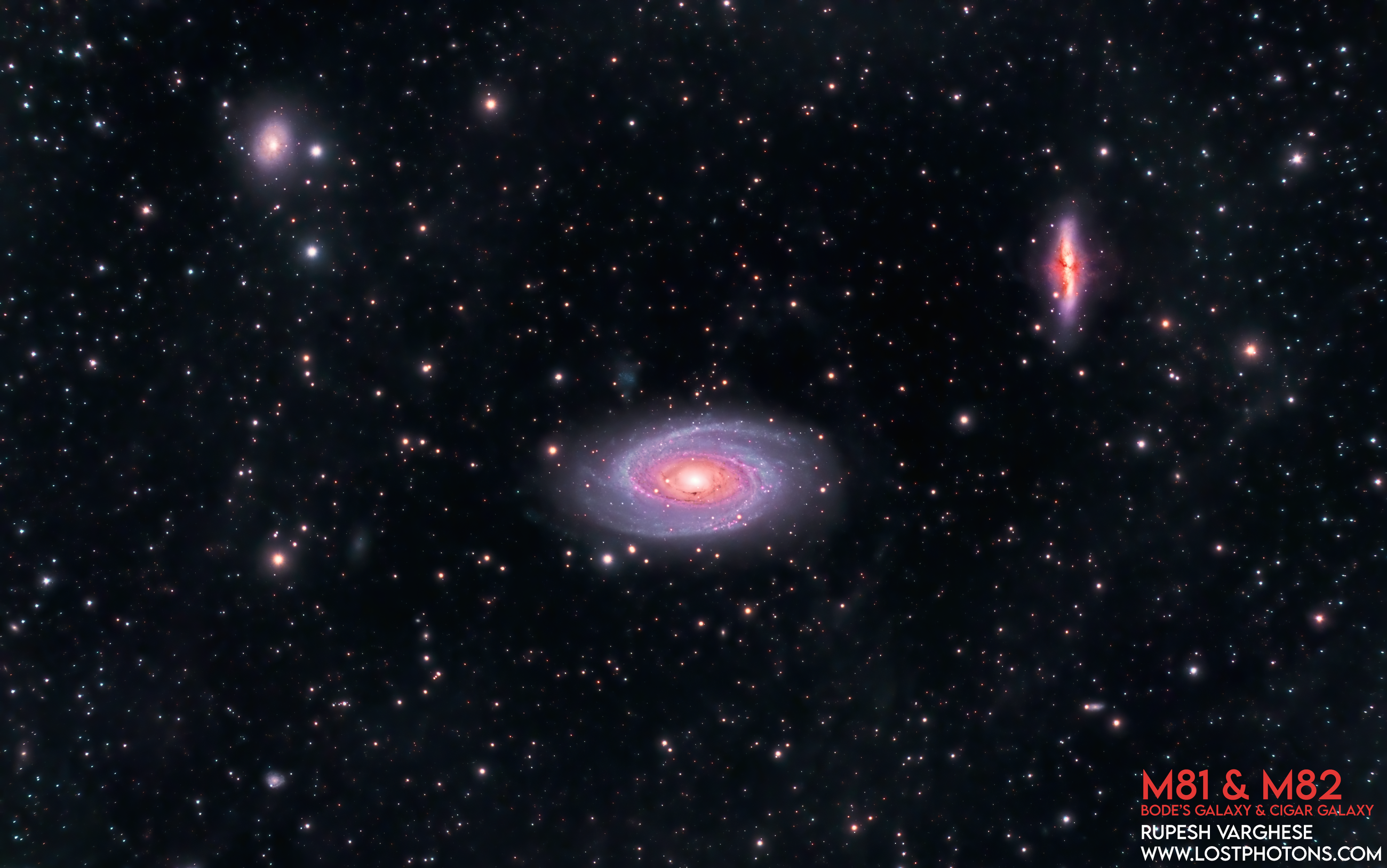
Older revision
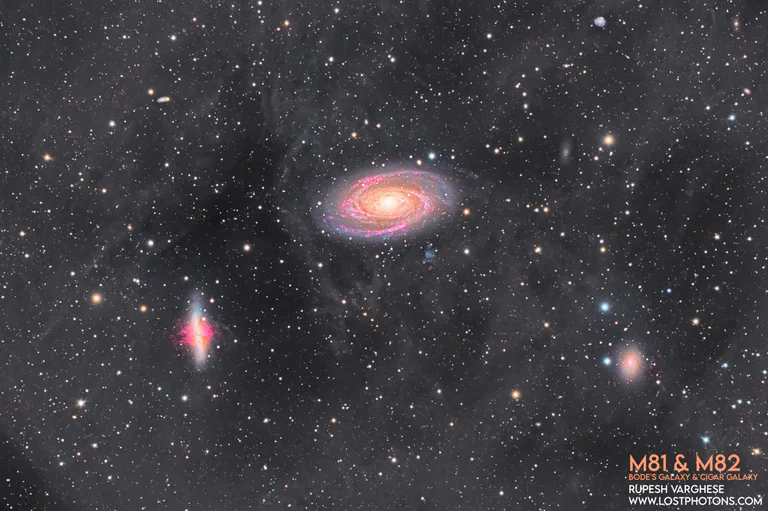
M81 / M82
Bode and Cigar Galaxies
Two very different galaxies in one field
M81 sits calm and spiral while M82 looks turbulent, dusty, and edge-on, a perfect contrast pair.
- What am I looking at?
- Bode's Galaxy (M81) and the Cigar Galaxy (M82) are a pair of galaxies interacting across millions of light-years.
- How far away is it?
- M81 is about 12 million light-years away; M82 is slightly closer.
- Where is it in the sky?
- In Ursa Major, near the Big Dipper bowl.
- Why does it matter?
- M82 is a starburst galaxy with a turbulent outflow; M81 is a classic grand-design spiral.
- When is the best time to photograph it?
- Spring nights when Ursa Major is high overhead.
Capture summary
Galaxy in Ursa Major
Natural color
Broadband RGB
Spring target / wide composition
- Optolong L-Pro 18h 45m 178 x 300s, 17 x 300s, 15 x 600s
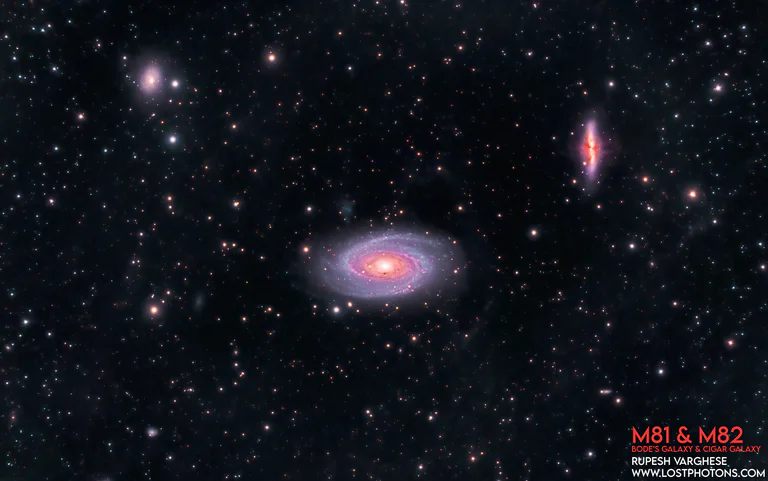
Same target, different years.
Older revisions stay in the archive so you can see how the target changed with different equipment, processing, and experience.
When to image this target
Galaxy in Ursa Major; best planned for March through May from New Jersey.
Spring favors higher galaxy fields and northern targets after evening twilight.
Assumes a New Jersey backyard horizon and evening imaging.
Prioritize transparency, darker skies, and long broadband integration.
M81 / M82 is listed here in Ursa Major.
Current frame: Natural color / Broadband RGB.
Live altitude, moon, and filter guidance
Calculating target altitude and moon context.
Use the full planner to enter a ZIP code, choose a date, and compare the target from your sky.
Based on the current time.
Green marks usable dark-sky altitude.
Next upper transit.
Approximate horizon crossing.
Moon phase and altitude.
Acquisition & processing notes
Filter channels, integration times, and capture dates for this frame.
- Optolong L-Pro 178 x 300s, 17 x 300s, 15 x 600s, 18h 45m
How I captured this
| Channel | Frames | Time |
|---|---|---|
| Optolong L-Pro | 178 x 300s, 17 x 300s, 15 x 600s | 18h 45m |
- Equipment used
- From my current rig
- Mount
- iOptron CEM60
- Telescope
- Explore Scientific FCD100 127mm Carbon Fiber Triplet APO
- Camera
- ZWO ASI2600MM Pro
- Filters
- Chroma 36mm Ha, OIII, SII, and LRGB (ZWO EFW 7×36mm)
- Focuser / rotator
- MoonLite NiteCrawler
- Reducer
- Starizona Apex ED 0.65×
- Guiding
- ZWO off-axis guider + ASI290MM Mini
- Control / power
- PrimaLuceLab Eagle 4S, Powerwerx PSU, Bioenno field battery, and MEGAbox