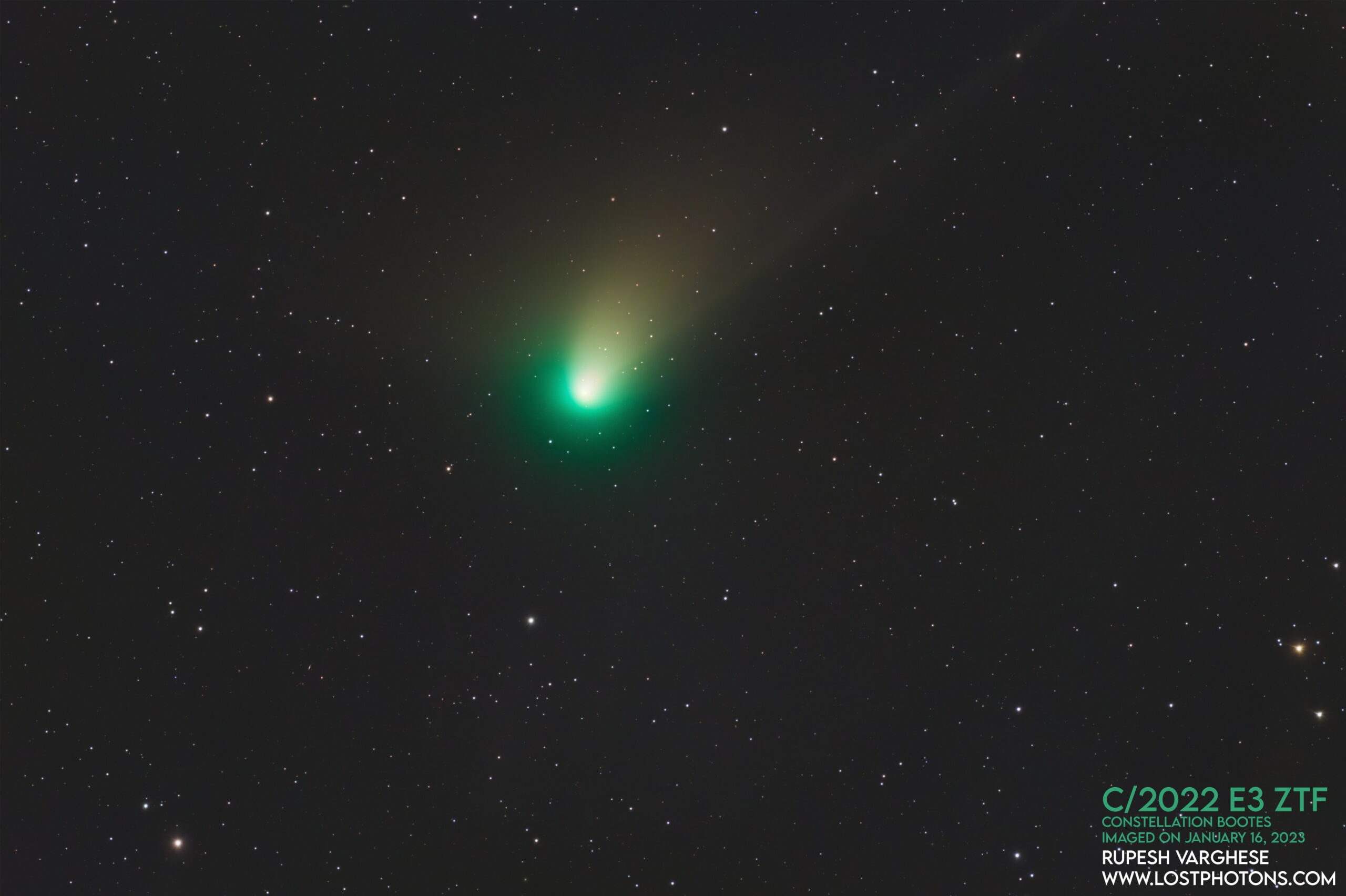
Comet C/2022 E3 ZTF was a welcome change of pace from deep-sky imaging. Unlike nebulae and galaxies, the subject is moving noticeably against the background stars, so the final image has a different kind of tension.
The green coma and dusty tail make the frame feel temporary in the best way. It is a record of a visitor passing through the inner solar system, caught during a short window before it moved on.
- What am I looking at?
- Comet C/2022 E3 (ZTF) is a long-period comet that made a close pass near Earth in early 2023, developing a green coma from diatomic carbon.
- How far away is it?
- Its orbit takes it far beyond the outer solar system between visits.
- Where is it in the sky?
- Comets move against the background stars; this one toured the northern sky in early 2023.
- Why does it matter?
- Bright comets are rare visitors and make excellent outreach targets for casual stargazers.
- When is the best time to photograph it?
- Whenever a comet is bright and well placed — they are time-sensitive targets.
Capture summary
Comet in Deep sky field
16 Jan 2023 / Moon 35%
Tracked comet stack
Winter target / wide composition
- Lum/Clear 30m 30s 61 x 30s / 16 Jan 2023 / Moon 35%
- R 30m 30s 61 x 30s / 16 Jan 2023 / Moon 35%
- G 30m 30s 61 x 30s / 16 Jan 2023 / Moon 35%
- B 30m 30s 61 x 30s / 16 Jan 2023 / Moon 35%
- Totals 2h 2m 16 Jan 2023 / Moon 35%
When to image this target
Comet in Deep sky field; best planned for December through February from New Jersey.
Winter targets reward clear, steady nights and usually climb well by late evening.
Assumes a New Jersey backyard horizon and evening imaging.
Check a current ephemeris before planning because comet brightness and position change quickly.
C/2022 E3 ZTF is listed here in Deep sky field.
Current frame: Natural color / Tracked comet stack.
Live altitude, moon, and filter guidance
Timing unavailable for this target type.
Use the full planner to enter a ZIP code, choose a date, and compare the target from your sky.
Based on the current time.
Green marks usable dark-sky altitude.
Next upper transit.
Approximate horizon crossing.
Moon phase and altitude.
Acquisition & processing notes
Filter channels, integration times, and capture dates for this frame. View on AstroBin.
- Lum/Clear 61 x 30s, 30m 30s, 16 Jan 2023, Moon 35%
- R 61 x 30s, 30m 30s, 16 Jan 2023, Moon 35%
- G 61 x 30s, 30m 30s, 16 Jan 2023, Moon 35%
- B 61 x 30s, 30m 30s, 16 Jan 2023, Moon 35%
- Totals 2h 2m, 16 Jan 2023, Moon 35%
How I captured this
| Channel | Frames | Time | Moon |
|---|---|---|---|
| Lum/Clear | 61 x 30s | 30m 30s | 35% |
| R | 61 x 30s | 30m 30s | 35% |
| G | 61 x 30s | 30m 30s | 35% |
| B | 61 x 30s | 30m 30s | 35% |
| Totals | — | 2h 2m | 35% |
- Equipment used
- From my current rig
- Mount
- iOptron CEM60
- Telescope
- Explore Scientific FCD100 127mm Carbon Fiber Triplet APO
- Camera
- ZWO ASI2600MM Pro
- Filters
- Chroma 36mm Ha, OIII, SII, and LRGB (ZWO EFW 7×36mm)
- Focuser / rotator
- MoonLite NiteCrawler
- Reducer
- Starizona Apex ED 0.65×
- Guiding
- ZWO off-axis guider + ASI290MM Mini
- Control / power
- PrimaLuceLab Eagle 4S, Powerwerx PSU, Bioenno field battery, and MEGAbox