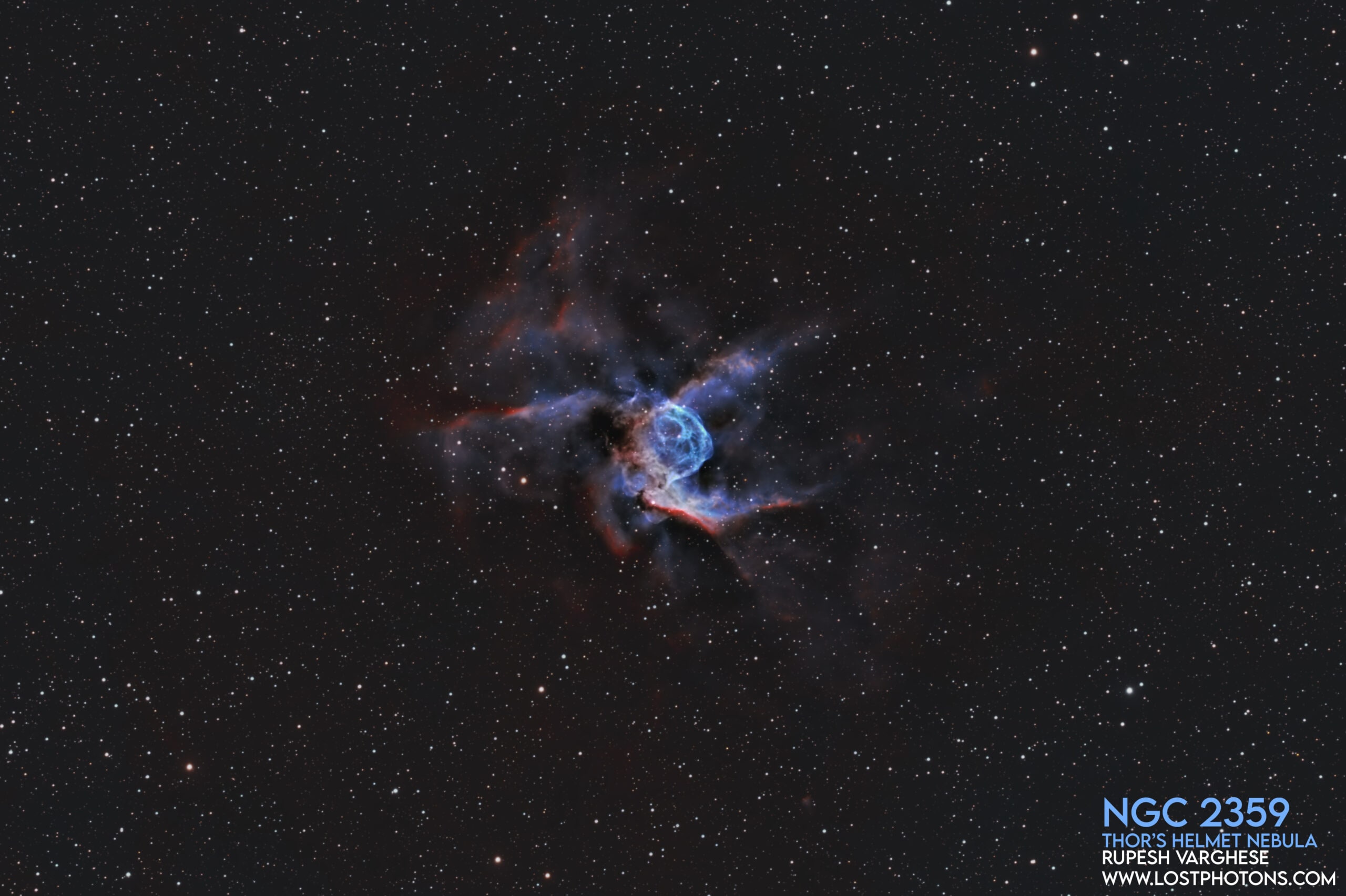
Thor’s Helmet is a wind-blown bubble around a Wolf-Rayet star in Canis Major. The bright shell has a sculptural shape that makes the target immediately recognizable, especially against the surrounding hydrogen field.
The Ha/OIII data gives the image its contrast: cooler oxygen tones trace the helmet-like bubble, while red hydrogen frames the surrounding gas. It is compact, bold, and a little strange in the best possible way.
- What am I looking at?
- Thor's Helmet is a wind-blown nebula around a hot Wolf-Rayet star, shaped like a medieval helmet.
- How far away is it?
- About 15,000 light-years away.
- Where is it in the sky?
- In Canis Major, near the bright star Sirius in winter.
- Why does it matter?
- Shows how extremely massive stars blow bubbles in surrounding gas before exploding.
- When is the best time to photograph it?
- Winter when Canis Major is high in the evening sky.
Capture summary
Nebula in Canis Major
Narrowband
Ha, OIII
Winter target / wide composition
Detailed filter totals have not been entered for this image yet.
When to image this target
Nebula in Canis Major; best planned for December through February from New Jersey.
Winter targets reward clear, steady nights and usually climb well by late evening.
Assumes a New Jersey backyard horizon and evening imaging.
Emission nebulae are good candidates for narrowband filters; reflection nebulae prefer darker skies.
NGC 2359 is listed here in Canis Major.
Current frame: Narrowband / Ha, OIII.
Live altitude, moon, and filter guidance
Calculating target altitude and moon context.
Use the full planner to enter a ZIP code, choose a date, and compare the target from your sky.
Based on the current time.
Green marks usable dark-sky altitude.
Next upper transit.
Approximate horizon crossing.
Moon phase and altitude.
Acquisition & processing notes
Filter channels, integration times, and capture dates for this frame.
Detailed acquisition breakdown has not been entered for this image yet. Check the Story tab for any notes included with the frame.
How I captured this
- Equipment used
- From my current rig
- Mount
- iOptron CEM60
- Telescope
- Explore Scientific FCD100 127mm Carbon Fiber Triplet APO
- Camera
- ZWO ASI2600MM Pro
- Filters
- Chroma 36mm Ha, OIII, SII, and LRGB (ZWO EFW 7×36mm)
- Focuser / rotator
- MoonLite NiteCrawler
- Reducer
- Starizona Apex ED 0.65×
- Guiding
- ZWO off-axis guider + ASI290MM Mini
- Control / power
- PrimaLuceLab Eagle 4S, Powerwerx PSU, Bioenno field battery, and MEGAbox