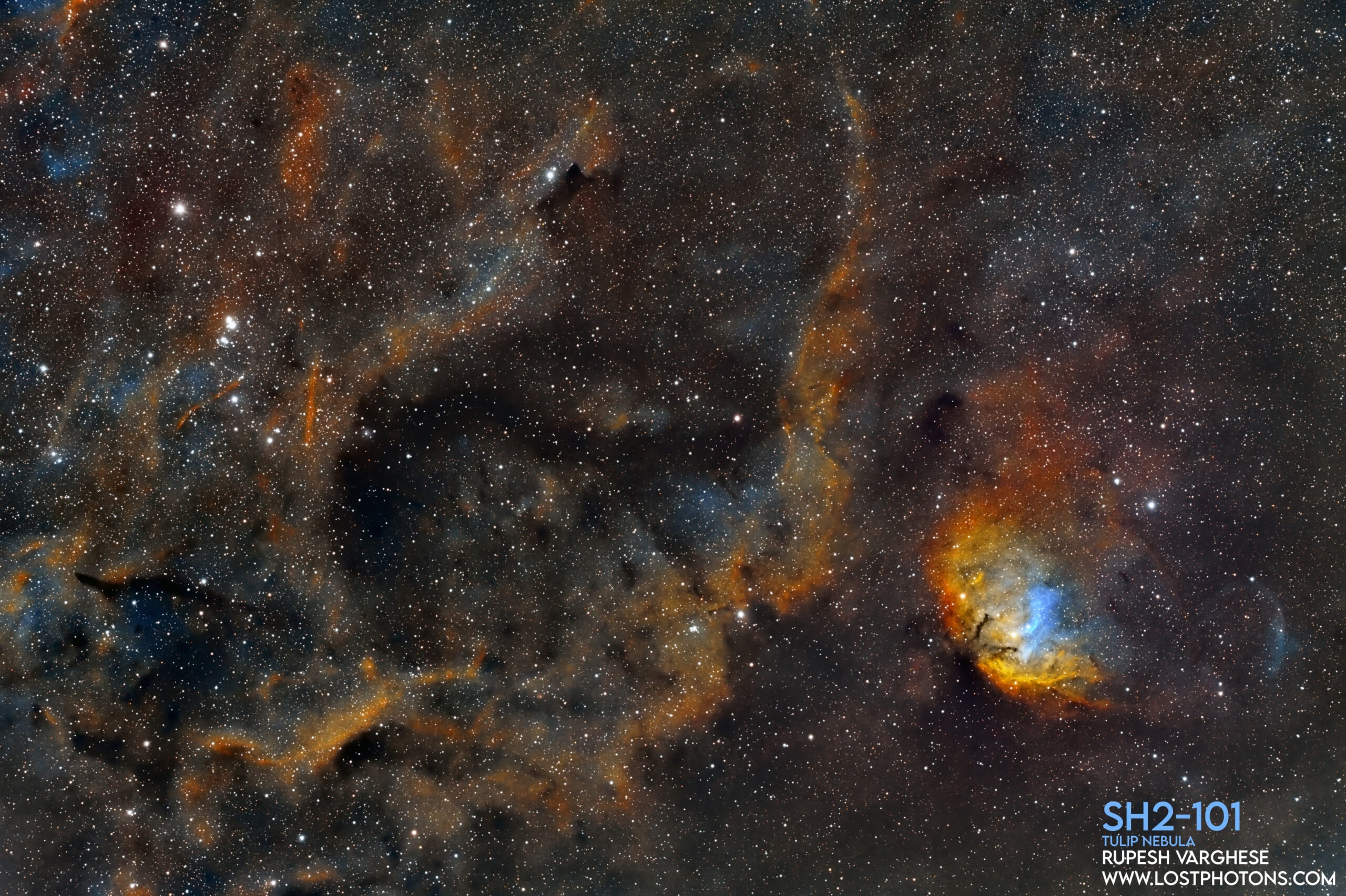
The Tulip Nebula sits in a busy Cygnus field, compact compared with the larger summer emission complexes but full of small structure. Its brighter folds and darker interior lanes make it feel carved out of the surrounding gas.
This narrowband version leans into that structure. Hydrogen, oxygen, and sulfur separate the nebula from the star field and give the compact target enough contrast to hold the frame.
- What am I looking at?
- A vivid compact nebula surrounded by dense Cygnus stars and subtle background emission.
- Where is it in the sky?
- Tulip Nebula (Sh2-101) lies in Cygnus, a summer constellation for mid-northern latitude observers.
- When is the best time to photograph it?
- Cygnus is best placed during summer (June through August), when it clears the horizon earlier in the night.
Capture summary
Nebula in Cygnus
29 Aug - 2 Sep 2022 / Moon 20%
Ha, OIII, SII
Summer target / wide composition
- H-alpha 3h 50m 46 x 300s / 4 days in 2022 / Moon 21%
- SII 3h 35m 43 x 300s / 31 Aug, 2 Sep 2022 / Moon 27%
- OIII 5h 60 x 300s / 29 Aug-1 Sep 2022 / Moon 15%
- Totals 12h 25m 29 Aug - 2 Sep 2022 / Moon 20%
When to image this target
Nebula in Cygnus; best planned for June through August from New Jersey.
Summer targets often improve later at night as the Milky Way climbs higher.
Assumes a New Jersey backyard horizon and evening imaging.
Emission nebulae are good candidates for narrowband filters; reflection nebulae prefer darker skies.
Sh2-101 is listed here in Cygnus.
Current frame: Narrowband / Ha, OIII, SII.
Live altitude, moon, and filter guidance
Calculating target altitude and moon context.
Use the full planner to enter a ZIP code, choose a date, and compare the target from your sky.
Based on the current time.
Green marks usable dark-sky altitude.
Next upper transit.
Approximate horizon crossing.
Moon phase and altitude.
Acquisition & processing notes
Filter channels, integration times, and capture dates for this frame. View on AstroBin.
- H-alpha 46 x 300s, 3h 50m, 4 days in 2022, Moon 21%
- SII 43 x 300s, 3h 35m, 31 Aug, 2 Sep 2022, Moon 27%
- OIII 60 x 300s, 5h, 29 Aug-1 Sep 2022, Moon 15%
- Totals 12h 25m, 29 Aug - 2 Sep 2022, Moon 20%
How I captured this
| Channel | Frames | Time | Moon |
|---|---|---|---|
| H-alpha | 46 x 300s | 3h 50m | 21% |
| SII | 43 x 300s | 3h 35m | 27% |
| OIII | 60 x 300s | 5h | 15% |
| Totals | — | 12h 25m | 20% |
- Equipment used
- From my current rig
- Mount
- iOptron CEM60
- Telescope
- Explore Scientific FCD100 127mm Carbon Fiber Triplet APO
- Camera
- ZWO ASI2600MM Pro
- Filters
- Chroma 36mm Ha, OIII, SII, and LRGB (ZWO EFW 7×36mm)
- Focuser / rotator
- MoonLite NiteCrawler
- Reducer
- Starizona Apex ED 0.65×
- Guiding
- ZWO off-axis guider + ASI290MM Mini
- Control / power
- PrimaLuceLab Eagle 4S, Powerwerx PSU, Bioenno field battery, and MEGAbox