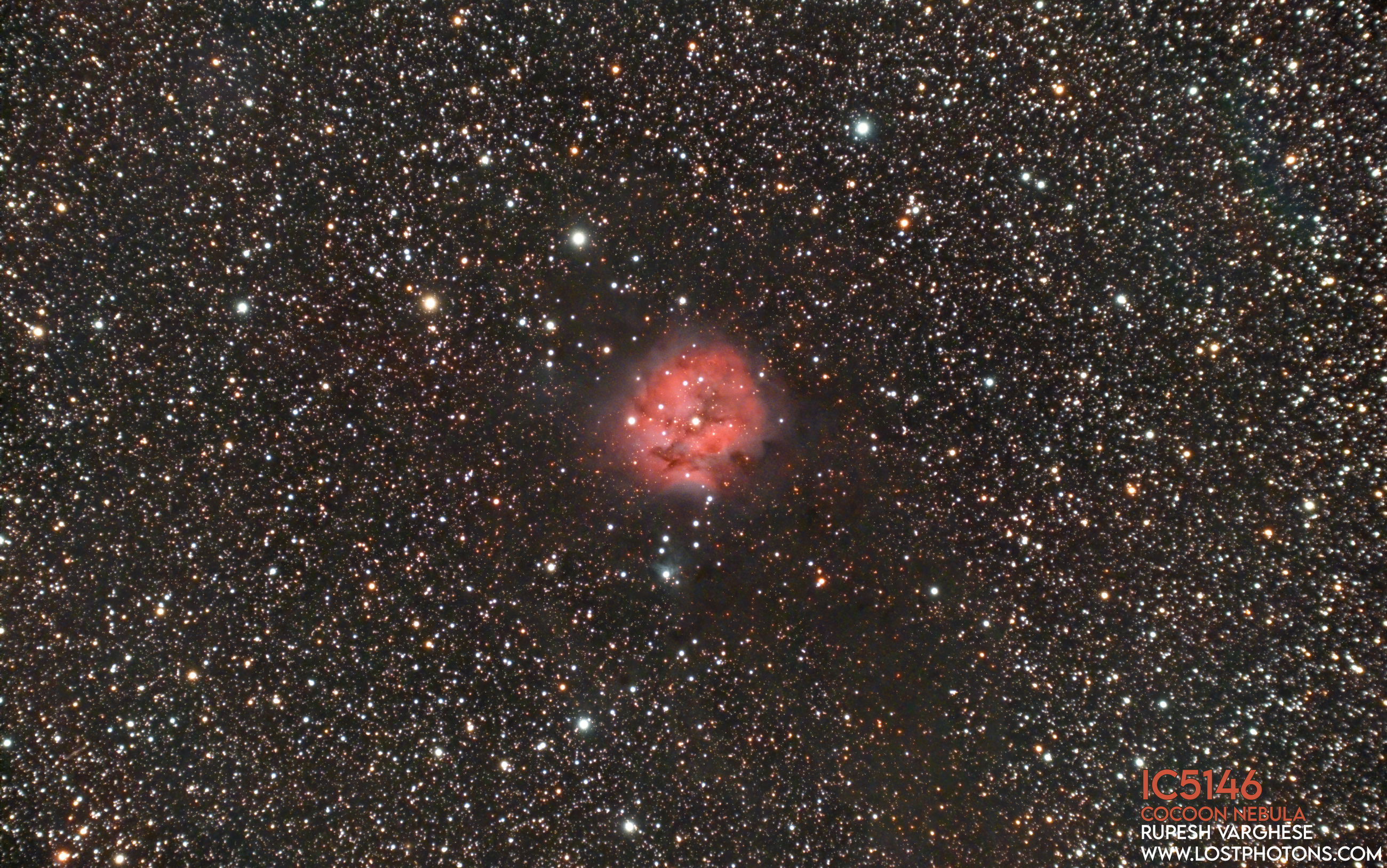
The Cocoon Nebula sits in a rich Cygnus field, combining emission, reflection, and surrounding dark dust.
This frame remains part of the Lost Photons archive.
- What am I looking at?
- The Cocoon Nebula is a star-forming region wrapped in a dark lane of dust that resembles a cocoon.
- How far away is it?
- About 4,000 light-years away.
- Where is it in the sky?
- In Cygnus, near the end of a long dark nebula visible in widefield images.
- Why does it matter?
- Pairs bright emission nebula with a dramatic dark dust lane in the same field.
- When is the best time to photograph it?
- Summer when Cygnus is high.
Capture summary
Nebula in Cygnus
Natural color
Broadband RGB
Summer target / wide composition
- Optolong L-Pro 2 1h 30m 18 x 300s
When to image this target
Nebula in Cygnus; best planned for June through August from New Jersey.
Summer targets often improve later at night as the Milky Way climbs higher.
Assumes a New Jersey backyard horizon and evening imaging.
Emission nebulae are good candidates for narrowband filters; reflection nebulae prefer darker skies.
IC 5146 is listed here in Cygnus.
Current frame: Natural color / Broadband RGB.
Live altitude, moon, and filter guidance
Calculating target altitude and moon context.
Use the full planner to enter a ZIP code, choose a date, and compare the target from your sky.
Based on the current time.
Green marks usable dark-sky altitude.
Next upper transit.
Approximate horizon crossing.
Moon phase and altitude.
Acquisition & processing notes
Filter channels, integration times, and capture dates for this frame.
- Optolong L-Pro 2 18 x 300s, 1h 30m
Field notes for this target.
Browse all capture notesHow I captured this
| Channel | Frames | Time |
|---|---|---|
| Optolong L-Pro 2 | 18 x 300s | 1h 30m |
- Equipment used
- From my current rig
- Mount
- iOptron CEM60
- Telescope
- Explore Scientific FCD100 127mm Carbon Fiber Triplet APO
- Camera
- ZWO ASI2600MM Pro
- Filters
- Chroma 36mm Ha, OIII, SII, and LRGB (ZWO EFW 7×36mm)
- Focuser / rotator
- MoonLite NiteCrawler
- Reducer
- Starizona Apex ED 0.65×
- Guiding
- ZWO off-axis guider + ASI290MM Mini
- Control / power
- PrimaLuceLab Eagle 4S, Powerwerx PSU, Bioenno field battery, and MEGAbox